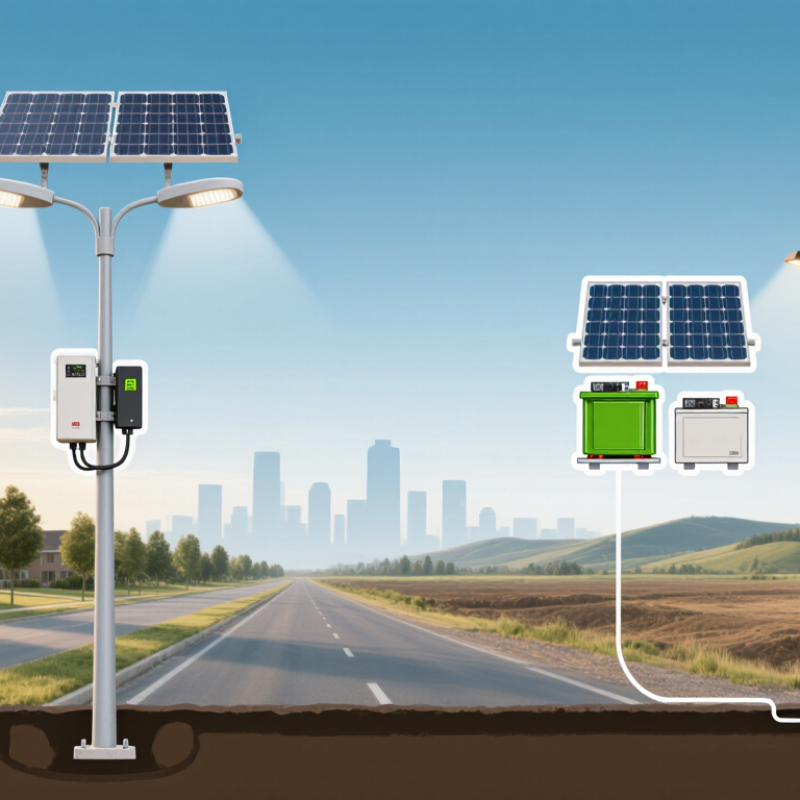
An Integrated Solar Led Street Light combines a photovoltaic panel, LED luminaire, battery, and controller in one outdoor unit. For municipalities, campuses, and remote roads, that design can reduce trenching and dependence on grid connections. Installation may be simpler. But a compact unit still needs careful sizing.
IRENA’s Renewable Power Generation Costs in 2023 reports that 81% of newly commissioned utility-scale renewable capacity produced electricity more cheaply than fossil-fuel alternatives. IRENA also estimated that new utility-scale solar photovoltaic electricity cost 56% less than the weighted average fossil-fuel alternative in 2023. These figures provide useful energy-sector context, not a guarantee of savings for street-light projects. Street-light economics also depend on local sunlight, battery replacement, pole spacing, maintenance access, and the cost of grid extension.
IRENA Director-General Francesco La Camera has said, “Renewables are the cheapest source of new power generation in most parts of the world today.” That perspective supports interest in solar-powered infrastructure, but it does not settle every purchasing decision. There is a catch. A shaded road, several cloudy days, or an undersized battery can leave a lamp dim when people need it. A sound comparison should examine lighting performance, autonomy, component warranties, and total operating costs—not just the panel rating or purchase price. The sections ahead explore where integrated systems fit, what their design changes, and which trade-offs deserve a closer look. Some projects may still be better served by grid-connected lights. That is worth admitting.
What Defines an Integrated Solar LED Street Light and Its Core Components?
An integrated solar LED street light brings the photovoltaic panel, battery, LED module, and charge controller into one compact assembly. Unlike split systems, it needs fewer separate cables between components. The panel converts daylight into electricity, while the rechargeable battery stores energy for nighttime use. The LED module produces light, and its lens helps direct the beam onto the road or walkway. That layout is convenient.
A controller manages charging and switches the light on when ambient light falls. Some models also include motion sensors, which can raise brightness when people or vehicles approach. The pole and mounting bracket hold the unit at a suitable height and angle; poor placement can reduce both sunlight exposure and useful road coverage. Battery capacity, panel size, and local winter conditions all affect how reliably the light operates. A cloudy week matters. Compact construction can simplify installation, but it may make component replacement less straightforward, so check whether the battery and controller are accessible before choosing a unit.
Why Choose an Integrated Solar LED Street Light?
Typical Service-Life Ranges of Core Components
An integrated solar LED street light combines a solar panel, rechargeable battery, LED module, and charge controller in one unit. Their service lives vary with product quality, climate, operating conditions, and maintenance; the ranges shown are typical planning estimates, not guarantees.
How 20–23% Efficient PV Modules Convert Sunlight Into Electricity
An integrated solar LED street light starts with a simple conversion: photovoltaic cells absorb sunlight and release electrons, creating direct-current electricity. Module efficiency describes how much incoming solar energy becomes electrical power. Fraunhofer ISE’s Photovoltaics Report (2024) documents the continued rise of commercial crystalline-silicon module performance, with efficient modules reaching the 20–23% range. At the standard test irradiance of 1,000 watts per square metre, that efficiency corresponds to roughly 200–230 watts per square metre before system losses. A useful benchmark.
The actual energy harvested outdoors varies. NREL’s standard test conditions use a module temperature of 25°C, but a sunlit panel can run much hotter. Heat, shade from trees, dust, and the panel’s tilt can all reduce output. Real streets are messier. A small shadow across part of a module may matter more than expected, so placement deserves careful attention.
In an integrated fixture, the module feeds a charge controller and battery during daylight; the battery powers the LED after dusk. Higher module efficiency can help a compact light collect more energy, especially where pole space is limited. Yet efficiency alone does not guarantee a full night of lighting. Battery capacity, local sunlight, and the chosen dimming schedule also shape performance. I would check seasonal solar data for the installation site, not just the module’s headline percentage.
How LED Efficacy of 150–200 lm/W Helps Reduce Lighting Power Demand
Why Choose an Integrated Solar LED Street Light?
How LED Efficacy of 150–200 lm/W Helps Reduce Lighting Power Demand
A high-efficacy LED delivers more useful light for every watt consumed. At 150–200 lumens per watt (lm/W), a 10,000-lumen target requires about 50–67 watts of LED input, before driver and optical losses. Lower demand can help an integrated solar street light use a smaller panel or battery, or preserve more energy for cloudy nights. The actual design still depends on operating hours, dimming schedules, temperature, and local sunlight.
The U.S. Department of Energy’s 2017 report, Adoption of Light-Emitting Diodes in Common Lighting Applications, projected that LED adoption could save 569 terawatt-hours of electricity annually in the United States by 2035. That broad estimate shows why efficacy matters at scale. For a single street, though, the number on a datasheet is not the whole story. Lens design, mounting height, and light distribution determine how much illumination reaches the pavement. A mismatch can waste energy, even with an efficient LED.
How LiFePO₄ Batteries Rated for 2,000+ Cycles Store Energy for Nighttime Use
An integrated solar LED street light stores daytime energy in its battery, then releases it after dusk. LiFePO₄ cells are often selected for their cycle life and thermal stability. A pack rated for 2,000 or more cycles may support years of nightly operation, but only under its stated test conditions. Depth of discharge, heat, and charging quality all matter. Night after night.
The U.S. National Renewable Energy Laboratory’s 2024 Annual Technology Baseline uses an 85% round-trip efficiency assumption for utility-scale battery storage. This is a useful industry reference, not a performance guarantee for a streetlight. In practice, a designer should compare the panel’s daily harvest with the lamp’s wattage and hours of operation, then leave reserve capacity for cloudy days. That estimate can look neat on paper; weather rarely is. A battery repeatedly drained to its limit may age faster than its cycle rating suggests, while a properly sized system can avoid unnecessary deep discharge. Check what the rating defines as a cycle and the remaining capacity at end of life. A cycle count alone does not tell the whole story.
How IP65 and IP66 Ratings Describe Protection Under IEC 60529
An integrated solar LED street light combines its panel, battery, controls, and luminaire in one outdoor assembly. Its enclosure must face dust, rain, and routine cleaning. The IP code offers a useful starting point, but it is not a full measure of product reliability. Details matter.
Under IEC 60529, the first numeral describes protection against solid objects and dust. In IP65 and IP66, the numeral 6 means the enclosure is dust-tight under the standard’s test conditions. The second numeral describes water protection. IP65 indicates resistance to water jets, while IP66 is tested against more powerful water jets. Neither rating means the light can be submerged. That distinction matters when choosing equipment for a site prone to flooding or standing water.
A higher water rating can help where wind-driven rain or hose cleaning is expected, but it cannot compensate for poor installation. Check that cable entries, gaskets, and access covers are correctly fitted; a loose gland can undermine the enclosure’s protection. The rating also does not describe resistance to corrosion, impact, or aging seals. In practice, those details are easy to overlook. Periodic inspection helps catch cracked seals or loose fittings before moisture reaches the electronics.